When evaluating tirzepatide, the Certificate of Analysis is one of the most important pieces of documentation associated with the sample.
But not all COAs provide the same information.
A single high purity percentage may look impressive, but it answers only one analytical question. A more complete COA provides information about what was tested, how the sample was identified, how much target peptide was present, and what additional testing was performed.
Here are some of the most important things to look for when reviewing tirzepatide laboratory results.
Clear Sample and Batch Identification
A useful COA starts with traceability.
The report should clearly identify the compound tested and connect the analytical results to the specific sample submitted to the laboratory.
Important information can include:
- Compound name
- Sample identification number
- Lot or batch number
- Client or manufacturer information, when applicable
- Date received
- Date testing was completed
- Laboratory performing the analysis
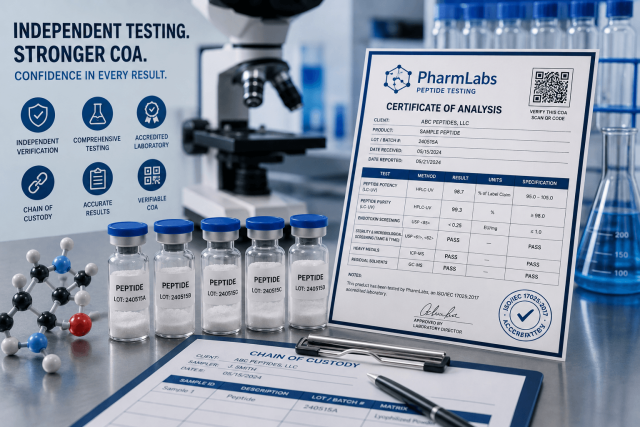
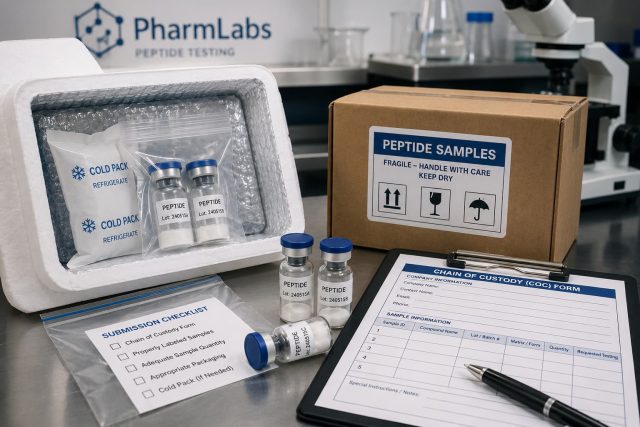
The identifying information on the COA should correspond with the sample submitted to the laboratory and the accompanying Chain of Custody documentation.
This helps ensure that the analytical results can be traced back to a specific sample or batch rather than simply presenting a generic tirzepatide result.
Tirzepatide Potency and Purity
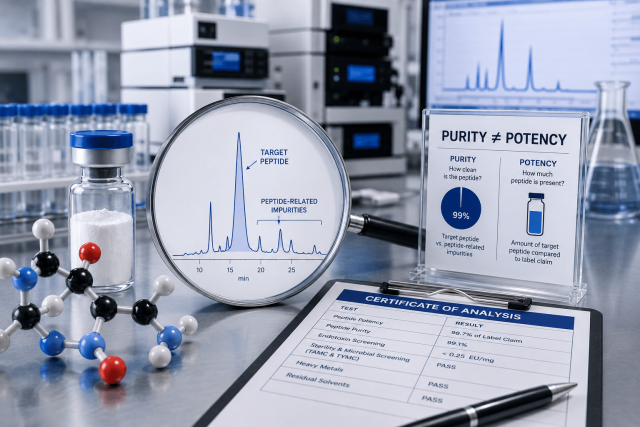
Potency and purity are two of the most important measurements on a tirzepatide COA, but they are frequently confused.
They answer different questions.
Potency measures the amount of the target peptide present in the sample.
Purity measures the percentage of the target peptide compared to peptide-related impurities.
That distinction matters.
A sample can have a very high purity percentage while containing less target peptide than expected. Likewise, knowing the amount of tirzepatide present does not tell you whether peptide-related impurities are also present.
For this reason, evaluating Potency & Purity together provides substantially more information than relying on a purity percentage alone.
Why a High Purity Result Isn’t the Entire Story
A result such as 99% purity can be valuable information, but it should be interpreted correctly.
Peptide purity evaluates the target peptide relative to peptide-related impurities detected by the analytical method.
It does not automatically tell you whether the sample has been evaluated for other potential contaminants.
For example, a purity determination is not designed to evaluate:
- Heavy metals
- Residual solvents
- Bacterial endotoxins
- Microbial contamination
These require separate analytical procedures.
This is why a tirzepatide COA containing only a purity result provides a much narrower picture than a COA supported by additional testing.
Method Sensitivity Matters
The number on the COA isn’t the only information that matters.
Understanding the sensitivity of the analytical method can provide important context for interpreting laboratory results.
Two useful measurements are:
Limit of Detection (LOD): The lowest concentration at which an analytical method can reliably detect an analyte.
Limit of Quantitation (LOQ): The lowest concentration at which an analytical method can reliably quantify an analyte under the established analytical conditions.
These values are particularly important when interpreting very low concentrations or results reported as Not Detected (ND).
An ND result does not necessarily mean that absolutely zero analyte exists in the sample. It means the analyte was not detected at or above the applicable capability or reporting threshold of the method.
When comparing tirzepatide testing laboratories, consider the method and its performance rather than comparing only the final number printed on the COA.
What Additional Testing Can Be Performed on Tirzepatide?
Potency & Purity provide important information about the target peptide, but additional testing can provide a broader assessment of the sample.
Endotoxin Screening
Endotoxin testing evaluates the sample for bacterial endotoxins.
Endotoxins are different from viable microbial contamination, which is why endotoxin testing is performed separately from microbial screening.
Sterility & Microbial Screening (TAMC & TYMC)
PharmLabs offers Sterility & Microbial Screening (TAMC & TYMC) to evaluate microbial contamination.
TAMC, or Total Aerobic Microbial Count, evaluates aerobic microbial contamination.
TYMC, or Total Yeast and Mold Count, evaluates yeast and mold contamination.
Together, these provide information about the microbial quality of the submitted sample.
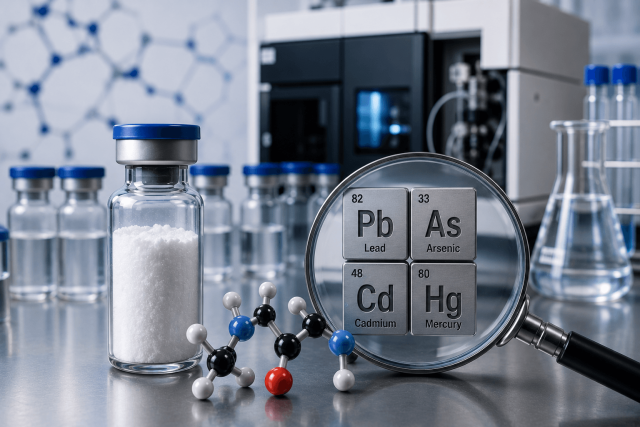
Heavy Metals
Heavy metals can potentially be introduced through raw materials, reagents, processing, manufacturing equipment, water, packaging, or other stages of production.
Because peptide purity testing is not designed to detect elemental contaminants, Heavy Metals testing requires a separate analytical procedure.
Residual Solvents
Solvents may be used during synthesis, purification, or other manufacturing processes.
Residual Solvents testing evaluates whether targeted solvents remain in the submitted sample.
Like Heavy Metals and Endotoxin Screening, Residual Solvents testing addresses a category that a peptide purity result alone does not evaluate.
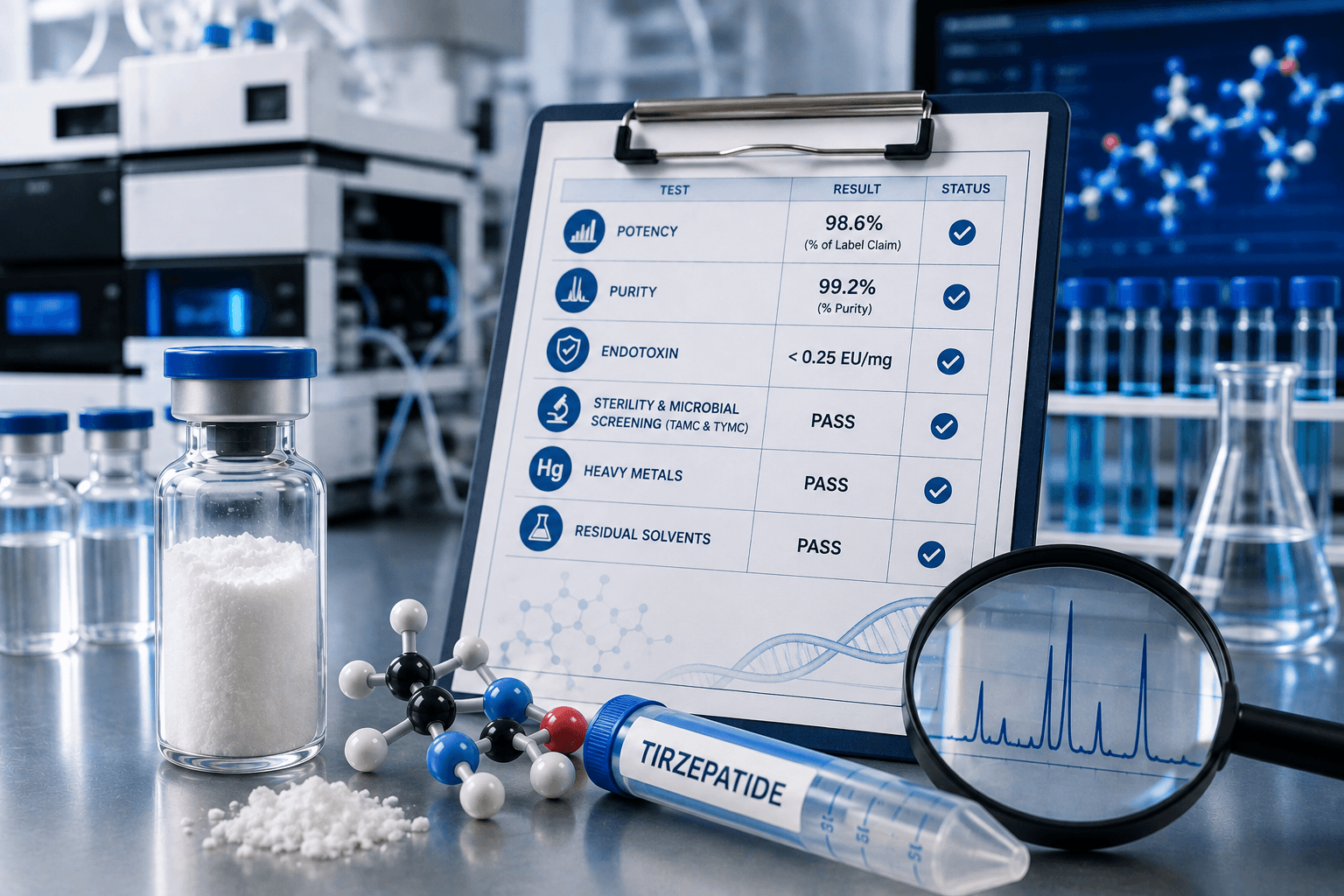
What Does a More Complete Tirzepatide COA Look Like?
There isn’t one single laboratory test that answers every question about a peptide sample.
Instead, a more comprehensive analytical picture comes from combining complementary tests.
For tirzepatide, that can include:
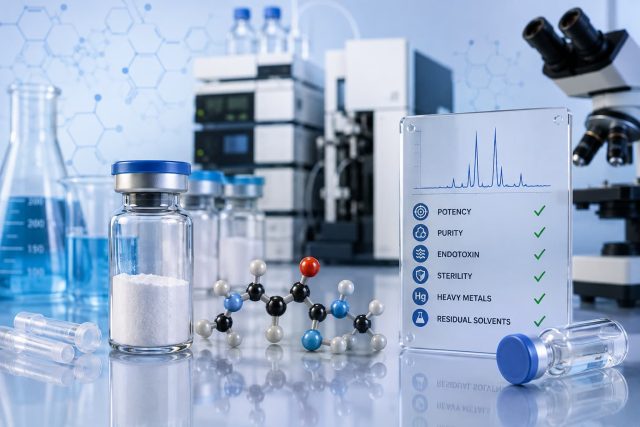
- Potency
- Purity
- Endotoxin Screening
- Sterility & Microbial Screening (TAMC & TYMC)
- Heavy Metals
- Residual Solvents
Each analysis evaluates something different.
Together, these results provide considerably more information than a purity percentage alone.
Why Independent Third-Party Testing Matters
Who generates the COA matters too.
A manufacturer may perform valuable internal quality-control testing throughout production. Independent third-party testing provides an additional layer of verification because the laboratory generating the results is separate from the company manufacturing or distributing the product.
For buyers and distributors, that independence can strengthen the value of the analytical documentation accompanying a batch.
When choosing a third-party tirzepatide testing laboratory, consider whether the laboratory is appropriately accredited and whether its accreditation can be independently verified.
PharmLabs is an ISO/IEC 17025:2017 accredited analytical laboratory, with peptide testing included within our accredited scope.
Make Sure the COA Is Verifiable
A COA is more useful when the recipient can verify that it is authentic.
PharmLabs Certificates of Analysis include a unique QR code for verification, allowing recipients to confirm the authenticity of the laboratory report.
This helps protect against altered, reused, or otherwise misrepresented laboratory documentation.
Combined with Chain of Custody records and batch identification, COA verification creates greater traceability between the sample submitted and the analytical results reported.
Complete Tirzepatide Testing at PharmLabs
PharmLabs offers Tirzepatide Potency & Purity testing as an individual service or as part of our Complete Peptide Testing Full Panel.
The Full Panel includes:
- Peptide Potency & Purity
- Endotoxin Screening
- Sterility & Microbial Screening (TAMC & TYMC)
- Heavy Metals
- Residual Solvents
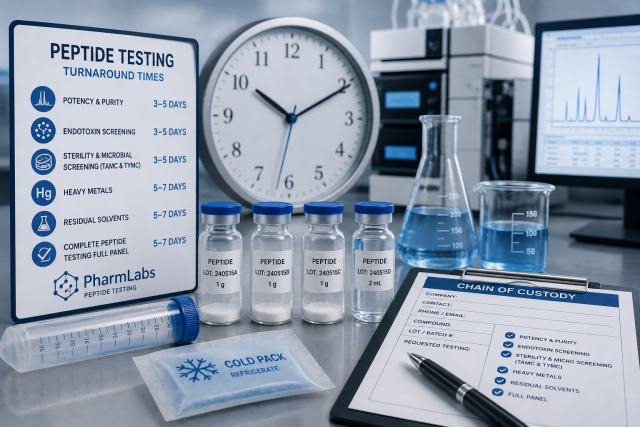
Standard Tirzepatide Potency & Purity testing is typically completed within 3–5 business days.
For clients requiring faster results, Same Day, 1-Business-Day, and 2-Business-Day rush options may be available for Potency & Purity depending on laboratory capacity.
The Complete Peptide Testing Full Panel is typically completed within 5–7 business days.
Don’t Evaluate Tirzepatide by One Number
A high purity percentage can be an important result, but it shouldn’t be the only number considered when evaluating a tirzepatide COA.
Look at the complete analytical picture:
Was the correct peptide identified?
How much target peptide was present?
What was the purity?
What additional testing was performed?
Can the results be traced to the specific batch?
Was the testing performed by an independent accredited laboratory?
Can the COA itself be verified?
Those questions provide substantially more information than simply asking whether a sample is “99% pure.”
Tirzepatide Testing From an Independent Accredited Laboratory
PharmLabs provides independent third-party tirzepatide testing from our ISO/IEC 17025:2017 accredited San Diego laboratory.
Clients receive Chain of Custody traceability, clear Certificates of Analysis, secure QR-code COA verification, and access to their results through our client portal.
And with our Price Match Guarantee, we’ll meet or beat a competitor’s price for comparable testing.