When submitting peptides for laboratory testing, one of the first questions is usually: How quickly can I get my results?
The answer depends on what you’re testing.
Peptide potency and purity, endotoxins, microbial contamination, heavy metals, and residual solvents require different analytical procedures. As a result, each test has its own turnaround time.
At PharmLabs, most peptide testing is completed within 3–7 business days, with rush testing available for Peptide Potency & Purity when results are needed sooner.
Understanding these timelines before submitting your samples can help you plan production, quality-control decisions, and product releases more effectively.
How Long Does Peptide Testing Take at PharmLabs?
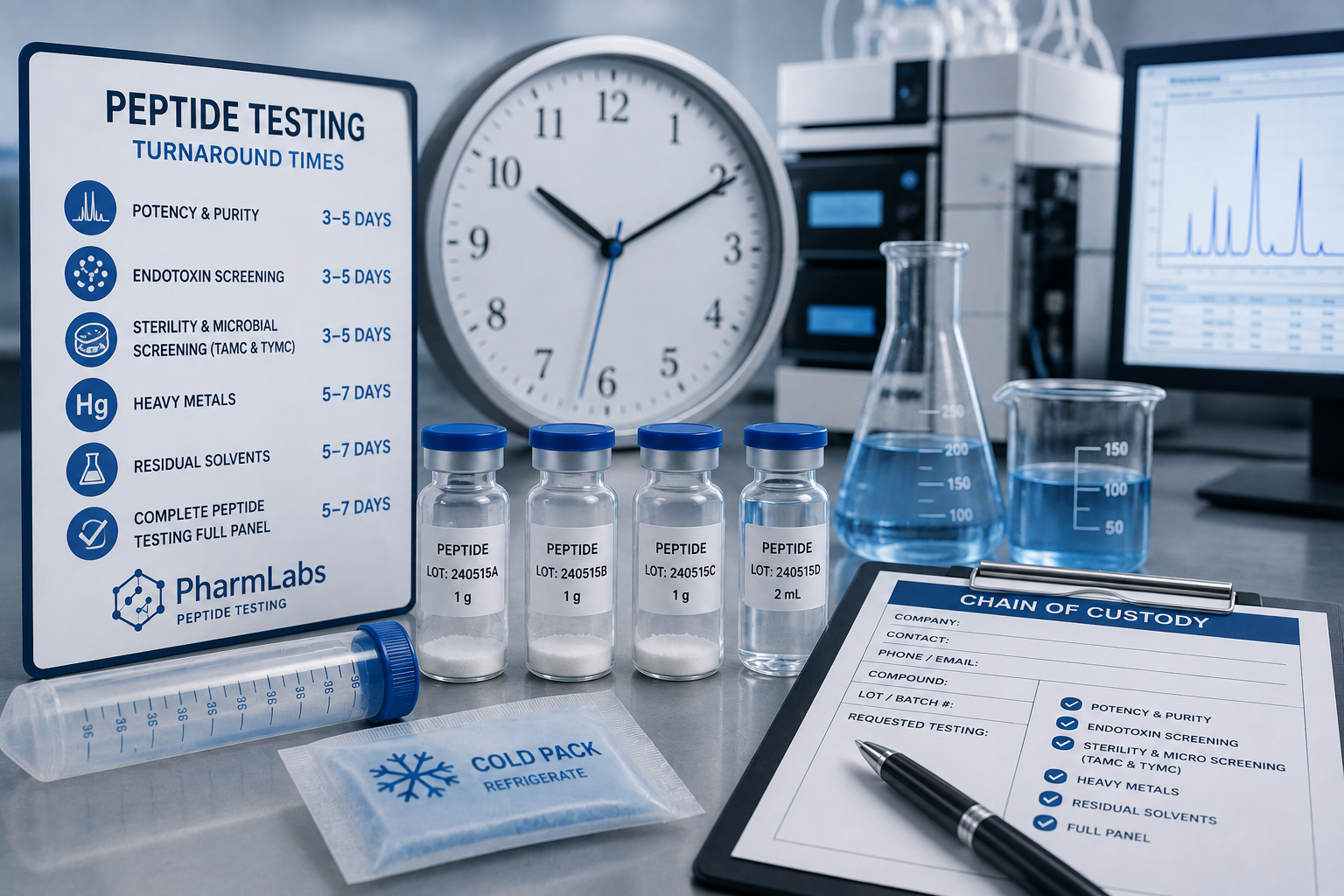
Our current standard turnaround times are:
- Peptide Potency & Purity: 3–5 business days
- Endotoxin Screening: 3–5 business days
- Sterility & Microbial Screening (TAMC & TYMC): 3–5 business days
- Heavy Metals: 5–7 business days
- Residual Solvents: 5–7 business days
- Complete Peptide Testing Full Panel: 5–7 business days
Turnaround time begins once the sample has been received and accepted by our laboratory.
Because different analyses can often be performed concurrently, ordering a Complete Peptide Testing Full Panel does not mean adding each individual turnaround time together. The complete panel is typically reported within 5–7 business days.
Which Peptide Tests Can Be Rushed?
PharmLabs currently offers rush service for Peptide Potency & Purity testing only.
Depending on laboratory capacity and the time your sample is received, rush options may include:
- Same Day
- 1 Business Day
- 2 Business Days
Rush testing prioritizes your sample within the laboratory workflow so it can move through preparation, analysis, data review, and reporting faster than a standard submission.
Because rush capacity can vary, we recommend contacting PharmLabs before shipping your samples if you have a specific deadline.
Why Aren’t All Peptide Tests Available as Rush Testing?
Different analyses require different laboratory processes.
Peptide Potency & Purity testing is instrument-based and can be prioritized within the laboratory workflow when capacity is available.
Other analyses may involve additional sample preparation, specialized instrumentation, microbiological procedures, or processing requirements that cannot simply be shortened by moving a sample ahead in the queue.
For this reason, PharmLabs currently limits rush peptide testing to Potency & Purity.
Endotoxin Screening, Sterility & Microbial Screening (TAMC & TYMC), Heavy Metals, and Residual Solvents are performed according to their standard turnaround times.
What Is Sterility & Microbial Screening (TAMC & TYMC)?
It is important to understand exactly what type of microbiological testing is being performed when comparing laboratory turnaround times.
PharmLabs offers Sterility & Microbial Screening (TAMC & TYMC) for peptide products.
TAMC, or Total Aerobic Microbial Count, evaluates the level of aerobic microbial contamination present in a sample.
TYMC, or Total Yeast and Mold Count, evaluates yeast and mold contamination.
Together, TAMC and TYMC provide important information about the microbial quality of a peptide product and can help identify potential contamination associated with manufacturing, handling, packaging, or storage.
How Long Does a Complete Peptide Testing Full Panel Take?
PharmLabs’ Complete Peptide Testing Full Panel has a standard turnaround time of approximately 5–7 business days.
The Full Panel includes:
- Peptide Potency & Purity
- Endotoxin Screening
- Sterility & Microbial Screening (TAMC & TYMC)
- Heavy Metals
- Residual Solvents
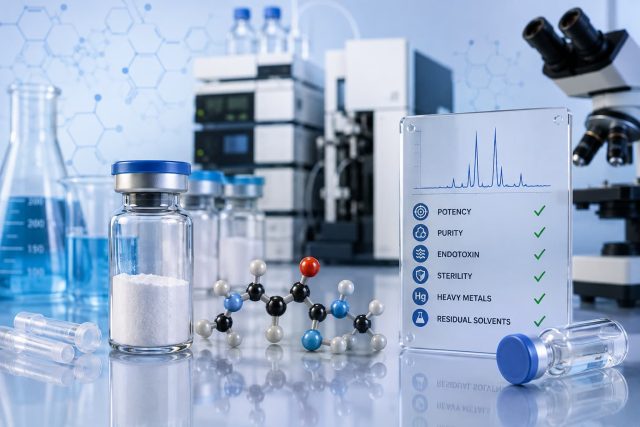
These analyses evaluate different aspects of peptide quality.
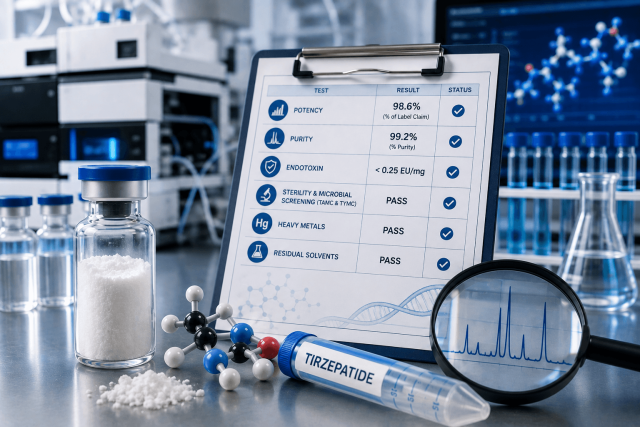
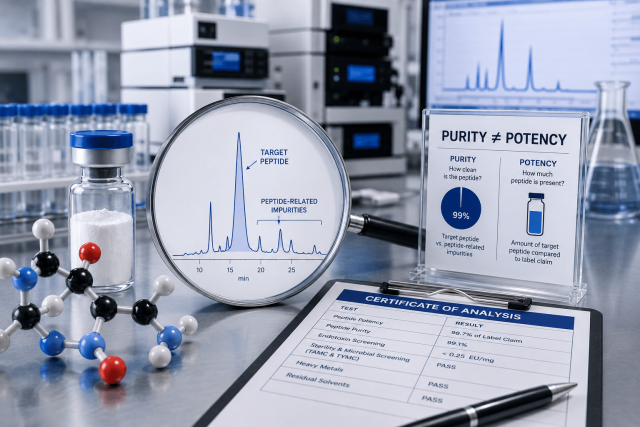
Potency measures the amount of the target peptide present in the sample.
Purity measures the percentage of the target peptide compared with peptide-related impurities.
The remaining analyses look for potential contaminants that Potency & Purity testing alone is not designed to evaluate.
For manufacturers and distributors looking for a broader assessment of peptide quality, the Complete Peptide Testing Full Panel provides substantially more information than a purity percentage alone.
What Can Delay Peptide Testing?
Even with an established analytical method, several avoidable issues can delay testing.
Insufficient Sample
Each analysis requires a minimum amount of material. If there isn’t enough sample to complete all requested testing, the laboratory may need to contact you and wait for additional material.
For a Complete Peptide Testing Full Panel, PharmLabs recommends submitting 7 g or 7 mL of sample.
Incomplete Chain of Custody
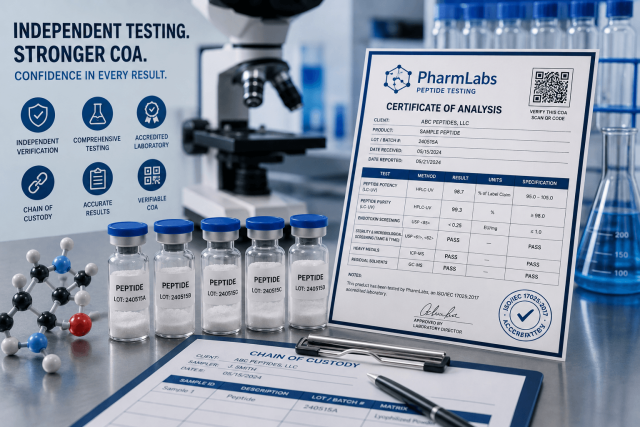
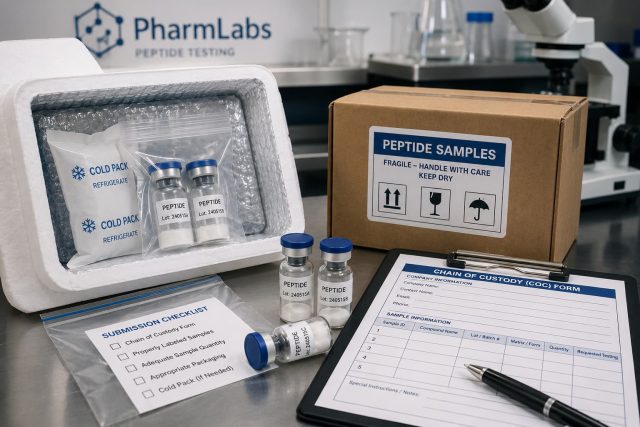
Your Chain of Custody (COC) tells the laboratory exactly what was submitted and what testing you are requesting.
Missing information can delay sample processing while the laboratory contacts you for clarification.
Mismatched Sample Labels
The sample name, compound, lot number, or batch number on the container should match the information provided on the COC.
Clear labeling helps maintain traceability and prevents unnecessary delays during sample intake.
Unusual Sample Matrices
Peptides can arrive as lyophilized powders, liquids, capsules, tablets, strips, blends, or other finished-product matrices.
Unusual formulations or ingredients can sometimes require additional evaluation or sample preparation before analysis.
Providing complete information about the sample when you submit it helps our laboratory anticipate these issues.
Shipping Time
Laboratory turnaround time generally begins after your sample arrives and is accepted for testing.
Shipping time therefore needs to be considered separately when planning around a deadline.
Using a domestic U.S. laboratory can help eliminate international customs delays and significantly reduce the time between shipping your sample and beginning analysis.
How Can I Get My Peptide Results Faster?
The easiest way to avoid unnecessary delays is to prepare your submission correctly from the beginning.
Before shipping:
- Confirm that PharmLabs currently tests your peptide.
- Determine which analyses you need.
- Verify the required sample quantity.
- Clearly label every sample.
- Complete your Chain of Custody.
- Use appropriate packaging for your sample.
- Contact us in advance if you require rush Potency & Purity testing.
If timing is critical, don’t wait until the sample arrives to ask about rush availability. Contact our Client Care team before shipping so we can confirm the fastest available option.
Where Do I Ship Peptide Samples?
Ship peptide samples directly to:
PharmLabs
6696 Mesa Ridge Rd, Ste A
San Diego, CA 92121
Include a completed Chain of Custody with your shipment and make sure each sample is clearly identified.
Fast Peptide Testing Without Sacrificing Quality
Fast turnaround is valuable, but speed should never replace reliable analytical testing.
When comparing peptide laboratories, consider more than the advertised turnaround time. Ask what method is being performed, whether the laboratory is accredited for the testing it provides, what its detection and quantitation limits are, and exactly what is included on the Certificate of Analysis.
PharmLabs is an ISO/IEC 17025:2017 accredited analytical laboratory providing independent third-party peptide testing from our San Diego facility.
With standard peptide testing completed in approximately 3–7 business days, rush Potency & Purity options, and a 5–7 business-day Complete Peptide Testing Full Panel, we make it easier to obtain comprehensive analytical results without unnecessary delays.
And with our Price Match Guarantee, we’ll meet or beat a competitor’s price for comparable testing.
Ready to Submit Your Peptides?
Contact PharmLabs to discuss your peptide testing requirements, confirm rush availability, or request a quote.
First Class. Accurate Results. Total Confidence.