Internal quality control is an important part of peptide manufacturing. In-house testing can help identify production problems, monitor consistency, qualify raw materials, and determine whether a batch meets internal specifications.
But when a Certificate of Analysis is being provided to a customer, distributor, or potential business partner, independent third-party testing adds something internal testing cannot: independent verification.
That’s why manufacturers increasingly use both.
In-House and Third-Party Testing Serve Different Purposes
A Certificate of Analysis can serve two important functions.
Internally, testing helps determine whether a batch meets your specifications. This is an essential manufacturing and quality-control function, and a qualified internal laboratory can provide valuable information throughout production.
Externally, the COA provides customers with documentation about the material they’re purchasing.
When that testing is performed by an independent third-party laboratory, the customer knows the analytical results were generated by an organization separate from the company manufacturing or selling the product.
That independence can make the COA considerably more valuable as a quality document.
Why Does Independent Peptide Testing Matter?
Third-party testing provides an additional level of confidence because the laboratory performing the analysis has no financial interest in whether a particular batch receives a high or low result.
This isn’t an argument that manufacturers cannot produce reliable internal data.
It’s about independent confirmation.
When a manufacturer produces a peptide and also generates the COA for that peptide, customers are being asked to rely entirely on the manufacturer’s own quality system.
An independent laboratory adds another layer of verification.
For manufacturers that already invest heavily in quality, third-party testing can help demonstrate that commitment to customers rather than simply asking them to take your word for it.
Third-Party Testing Can Strengthen Your Product Documentation
In a competitive peptide market, manufacturers and distributors need ways to differentiate their products beyond price.
Independent analytical testing can help.
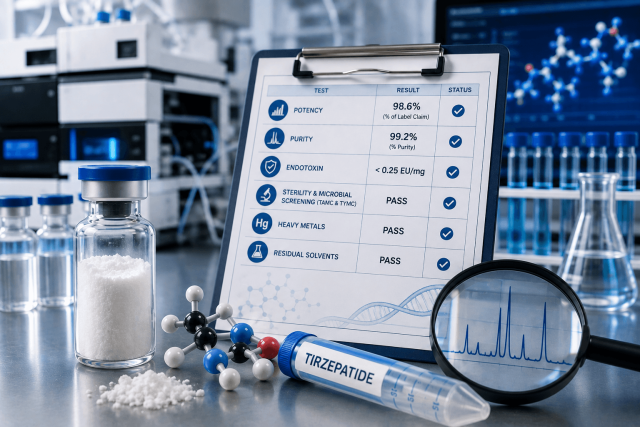
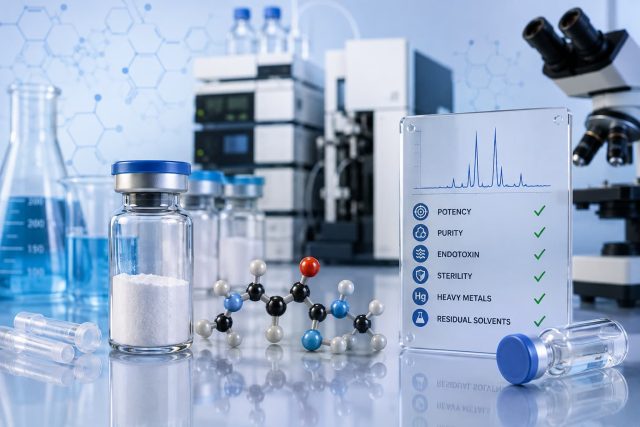
A third-party COA can provide customers with objective information about:
- Peptide Potency
- Peptide Purity
- Endotoxin Screening
- Sterility & Microbial Screening (TAMC & TYMC)
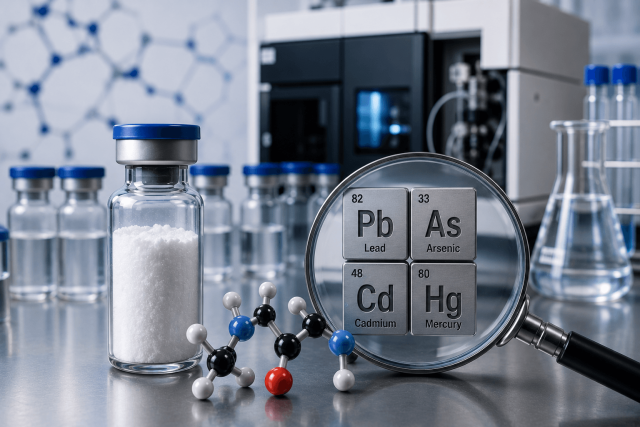
- Heavy Metals
- Residual Solvents
Instead of simply making claims about product quality, manufacturers can provide analytical results generated by an independent laboratory.
That can be particularly valuable when qualifying new suppliers, establishing relationships with distributors, comparing batches, or responding to customer quality questions.
A Strong COA Is More Than a Purity Percentage
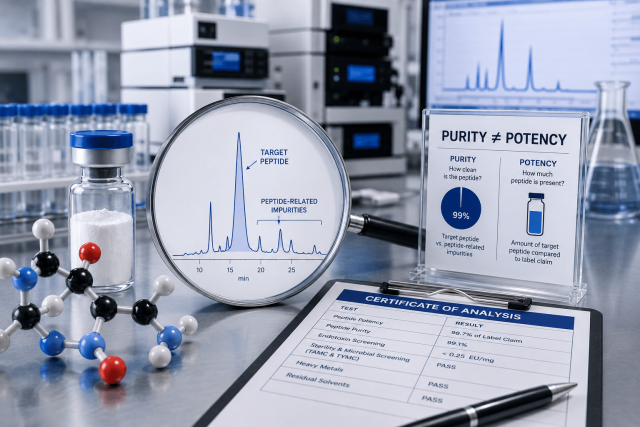
A peptide advertised as 99% pure may sound impressive, but purity represents only one aspect of the sample.
Purity measures the percentage of the target peptide compared to peptide-related impurities.
Potency measures the amount of the target peptide present in the sample.
Those are two different measurements, and neither one alone evaluates every potential contaminant.
Heavy metals, residual solvents, endotoxins, and microbial contamination require separate analytical procedures.
For manufacturers seeking a broader assessment, a COA containing multiple complementary analyses can provide substantially more information than a purity percentage alone.
What Makes Third-Party Peptide Testing Credible?
Not every laboratory or COA provides the same level of confidence. When selecting an independent peptide testing laboratory, there are several things worth evaluating.
ISO/IEC 17025 Accreditation
ISO/IEC 17025 is the international standard used to assess the competence of testing and calibration laboratories.
However, simply stating that a laboratory is “ISO accredited” isn’t enough.
Accreditation applies to a laboratory’s defined Scope of Accreditation, so manufacturers should verify that the laboratory’s scope covers the relevant testing.
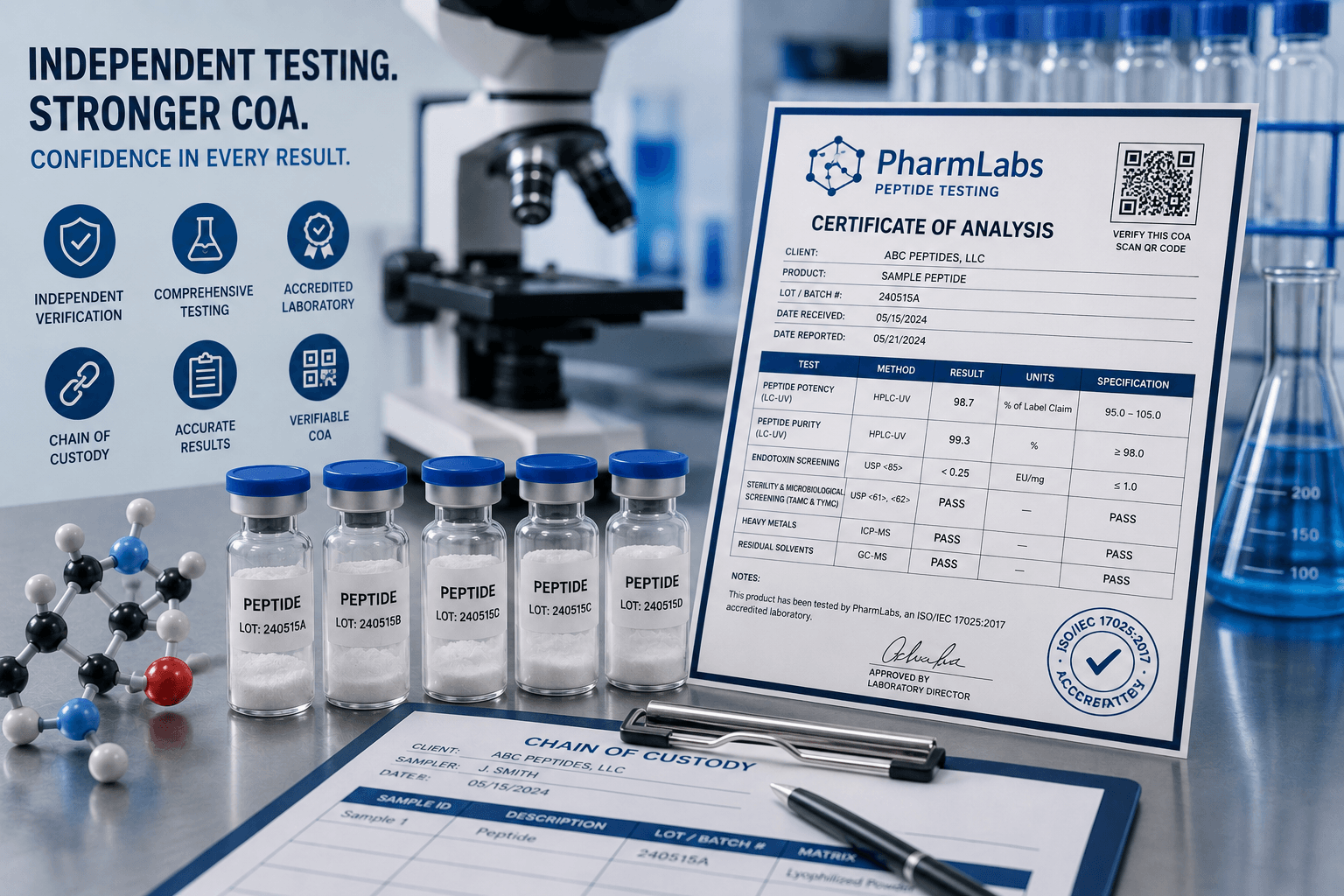
PharmLabs is an ISO/IEC 17025:2017 accredited analytical laboratory, with peptide testing included within our accredited scope.
Chain of Custody
Traceability begins before the sample reaches an instrument.
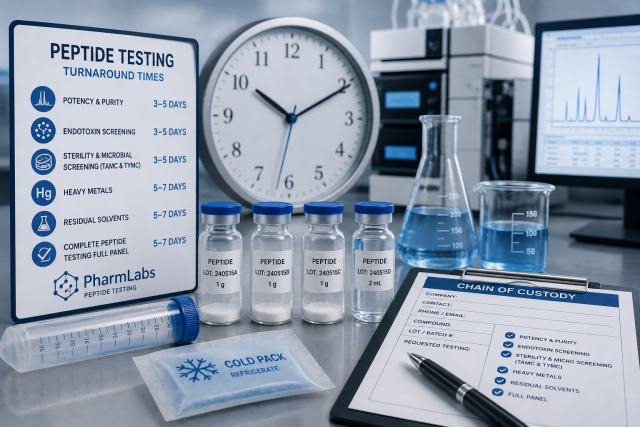
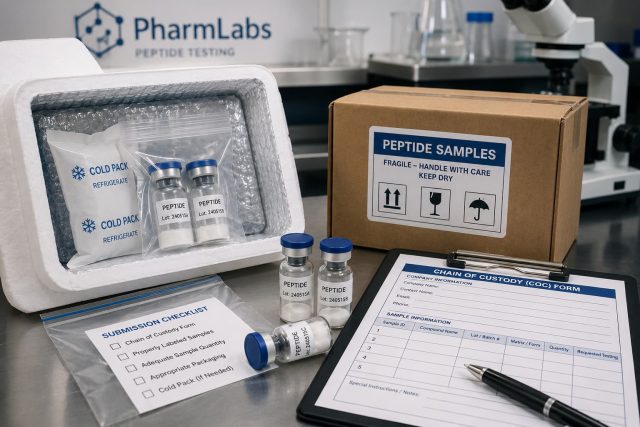
A properly completed Chain of Custody (COC) connects the sample submitted by the client with the testing requested and the resulting Certificate of Analysis.
Sample names, lot numbers, batch numbers, and other identifiers should remain traceable throughout the laboratory process.
Verifiable Certificates of Analysis
A COA is more valuable when customers can verify that it is authentic.
PharmLabs Certificates of Analysis include a unique QR code that allows the report to be verified against the laboratory record.
This provides customers, distributors, and other recipients with a way to confirm that the COA they received is associated with an authentic PharmLabs laboratory result.
Appropriate Testing
A credible testing program should also match the questions you’re trying to answer.
If you only need to verify peptide content, Potency & Purity testing may be appropriate.
If you want a broader assessment of the product, additional testing may be necessary.
Go Beyond Potency & Purity
PharmLabs’ Complete Peptide Testing Full Panel combines:
- Peptide Potency & Purity
- Endotoxin Screening
- Sterility & Microbial Screening (TAMC & TYMC)
- Heavy Metals
- Residual Solvents
Each test answers a different question about the sample.
Together, they provide manufacturers and distributors with a more comprehensive analytical picture than relying on a purity result alone.
Use Internal QC and Independent Testing Together
Third-party testing doesn’t need to replace internal quality control.
In fact, the two work particularly well together.
Use internal testing to monitor manufacturing, identify problems early, and maintain process consistency.
Then use an independent laboratory to verify finished products or selected batches and provide the documentation your customers will see.
Internal QC helps you control your process.
Independent testing helps you demonstrate your results.
Independent Peptide Testing at PharmLabs
PharmLabs provides independent third-party peptide testing from our ISO/IEC 17025:2017 accredited San Diego laboratory.
We test more than 14 peptide compounds and offer individual analyses as well as our Complete Peptide Testing Full Panel.
Clients receive clear Certificates of Analysis, Chain of Custody traceability, secure COA verification, and access to results through our client portal.
Standard peptide testing is generally completed within 3–7 business days, depending on the analyses requested, with rush testing available for Peptide Potency & Purity.
And because quality testing also needs to make financial sense, PharmLabs offers a Price Match Guarantee — we’ll meet or beat a competitor’s price for comparable testing.
Give Your Customers More Than a Claim
Your internal quality program tells you what you made.
Independent third-party testing helps you prove it.
When your customers can see who performed the testing, verify the laboratory’s accreditation, trace the results to a specific batch, and authenticate the COA, your laboratory documentation becomes more than another piece of paperwork.
It becomes independent evidence supporting the quality of your product.