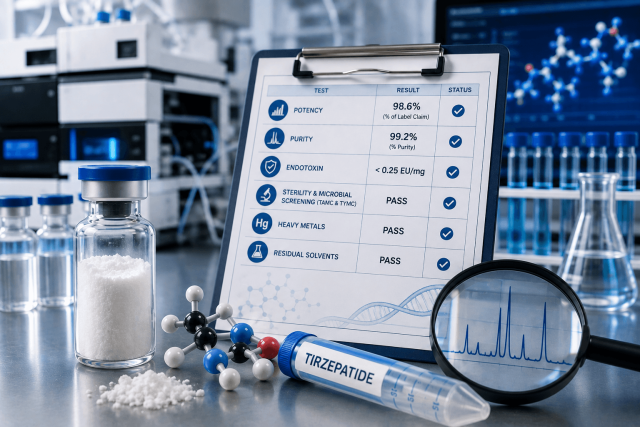
When evaluating peptide quality, Potency & Purity usually receive most of the attention.
But a high purity result does not tell you whether a peptide product contains heavy metals.
That’s because peptide purity and heavy metals testing answer completely different analytical questions and require different testing methods.
A peptide can have an excellent purity result while still containing trace metals introduced through raw materials, synthesis, processing, equipment, water, or packaging.
That’s why heavy metals testing can be an important part of a broader peptide quality program.
Where Do Heavy Metals in Peptide Products Come From?
Heavy metals are generally not something a manufacturer intentionally adds to a peptide product.
Instead, trace metals can be introduced at different stages of manufacturing and handling.
Understanding those potential sources helps explain why testing the finished material can be valuable.
Raw Materials and Reagents
Peptide synthesis requires numerous raw materials, reagents, and processing chemicals.
Depending on their source, grade, and manufacturing controls, these materials may contain trace amounts of elemental contaminants.
When multiple materials are introduced throughout a manufacturing process, each represents a potential source of contamination.
Synthesis and Processing
Manufacturing processes themselves can introduce elemental impurities.
Certain synthetic processes may involve catalysts or other metal-containing materials. If those materials are used, purification becomes important for reducing residual metals in the finished product.
Even when metals aren’t intentionally part of the synthesis, contamination can potentially be introduced during processing.
Manufacturing Equipment
Peptide materials may contact reactors, vessels, tubing, filters, pumps, fittings, and other processing equipment.
Wear, corrosion, surface degradation, or inappropriate materials of construction can potentially introduce trace elements into a product.
This means equipment maintenance and manufacturing controls can influence the elemental profile of the finished material.
Water
Water quality is another potential source.
Water may be used during synthesis, purification, cleaning, or other manufacturing processes.
The effectiveness of the water purification system and the controls surrounding it can therefore affect the potential for elemental contamination.
Packaging and Storage
The manufacturing process isn’t necessarily the final opportunity for contamination.
Containers, closures, and other packaging components can potentially interact with a product during storage.
Packaging materials should therefore be considered as part of the overall quality system, particularly when investigating an unexpected result.
Supplier and Upstream Contamination
Sometimes contamination originates before a manufacturer ever receives the material.
Raw materials or intermediates supplied by another company may already contain trace metals.
This is one reason independent testing can be particularly useful when qualifying a new supplier or evaluating a new source of material.
Which Heavy Metals Are Commonly Tested?
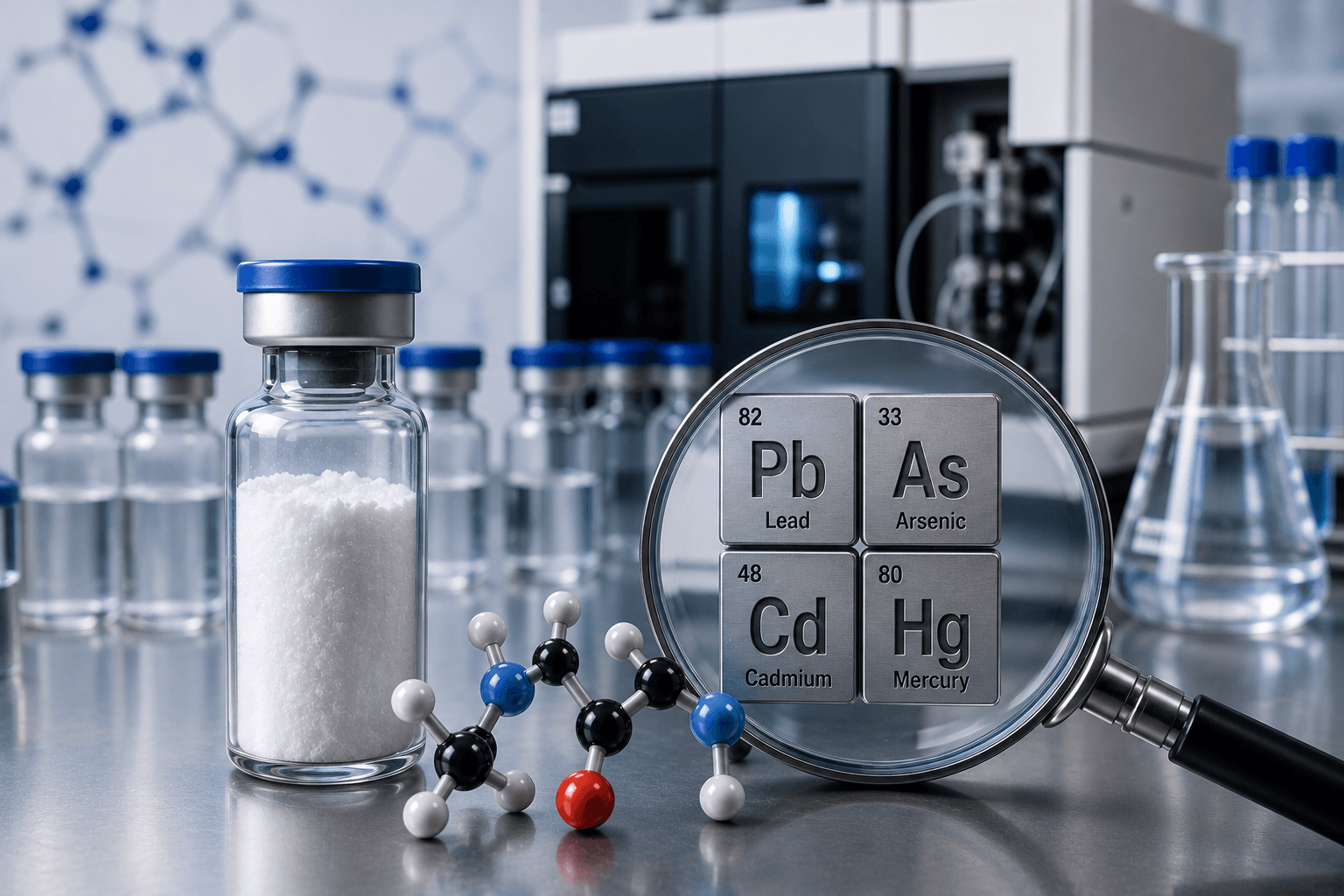
Heavy metals testing commonly focuses on elements with well-established toxicological concerns, including:
- Lead
- Arsenic
- Cadmium
- Mercury
Depending on the manufacturing process and testing objectives, additional elements may also be appropriate.
For example, a process involving particular catalysts or manufacturing equipment could justify evaluating additional process-specific elemental impurities.
The appropriate testing panel should therefore reflect the material, manufacturing process, and quality objectives rather than simply assuming every product has the same potential sources of contamination.
Why Doesn’t Peptide Purity Testing Detect Heavy Metals?
This is an important distinction.
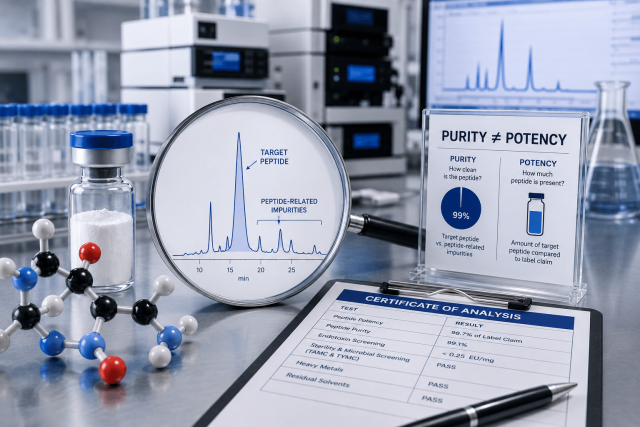
Purity measures the percentage of the target peptide compared to peptide-related impurities.
Heavy metals are not peptide-related impurities.
As a result, a chromatographic purity result is not designed to tell you whether lead, arsenic, cadmium, mercury, or other elemental contaminants are present.
Heavy metals require a separate analytical procedure specifically designed to detect and quantify elements at very low concentrations.
This means a peptide can report very high purity while still requiring separate heavy metals testing to evaluate elemental contamination.
The purity result isn’t wrong.
It simply answers a different question.
How Are Heavy Metals Tested?
Heavy metals are commonly analyzed using highly sensitive elemental analysis techniques such as Inductively Coupled Plasma Mass Spectrometry (ICP-MS).
Unlike peptide Potency & Purity testing, elemental analysis generally requires the sample to undergo a separate preparation process before being introduced into the instrument.
The technique allows laboratories to evaluate elements at very low concentrations.
Because heavy metals analysis uses different sample preparation, instrumentation, analytical standards, and calculations, it is performed separately from Peptide Potency & Purity testing.
Why Do Detection and Quantitation Limits Matter?
A laboratory result is most useful when you understand the sensitivity of the analytical method.
Two important terms are:
Limit of Detection (LOD): The lowest concentration at which the method can reliably detect the presence of an analyte.
Limit of Quantitation (LOQ): The lowest concentration at which the method can reliably quantify that analyte under the established analytical conditions.
These limits provide important context for results reported at very low concentrations.
They are especially important when interpreting a result reported as Not Detected (ND).
An ND result does not mean that absolutely zero of an element exists in the sample. It means the element was not detected at or above the applicable capability or reporting threshold of the method.
When comparing laboratories, consider both which elements are being tested and the sensitivity of the method being used.
When Should Peptide Manufacturers Consider Heavy Metals Testing?
Heavy metals testing can be useful at several stages of a quality program.
Qualifying a New Supplier
Testing material from a new supplier can provide independent information about its elemental profile before establishing an ongoing relationship.
Evaluating New Raw Materials
A change in raw-material source can introduce new variables into the manufacturing process.
Testing can help determine whether that change also affected elemental contamination.
Changing Manufacturing Processes or Equipment
New equipment, processing conditions, catalysts, or other manufacturing changes can alter the potential sources of elemental impurities.
Heavy metals testing can provide additional information when evaluating those changes.
Investigating an Unexpected Quality Issue
When a product produces an unexpected analytical result or raises a quality concern, elemental analysis can help determine whether metals are contributing to the issue.
Finished-Product Quality Testing
Manufacturers and distributors may also choose to include heavy metals as part of a broader finished-product testing program rather than relying exclusively on Peptide Potency & Purity.
The appropriate testing frequency should ultimately be based on the organization’s quality program, manufacturing process, supplier controls, and testing objectives.
Heavy Metals Are Only One Part of the Picture
Heavy metals testing provides important information, but it doesn’t replace other peptide analyses.
Each test answers a different question.
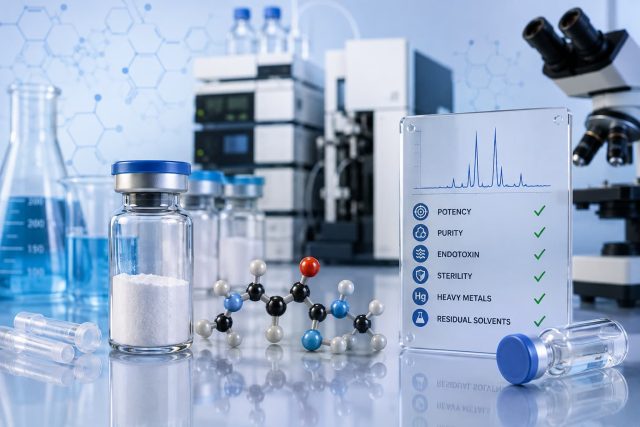
Peptide Potency & Purity evaluates the target peptide and peptide-related impurities.
Heavy Metals evaluates elemental contamination.
Residual Solvents evaluates solvents that may remain from manufacturing or processing.
Endotoxin Screening evaluates bacterial endotoxins.
Sterility & Microbial Screening (TAMC & TYMC) evaluates microbial contamination.
Looking at these analyses together provides a substantially broader picture of a peptide product than a purity percentage alone.
Complete Peptide Testing at PharmLabs
PharmLabs offers Heavy Metals testing individually or as part of our Complete Peptide Testing Full Panel.
The Full Panel includes:
- Peptide Potency & Purity
- Endotoxin Screening
- Sterility & Microbial Screening (TAMC & TYMC)
- Heavy Metals
- Residual Solvents
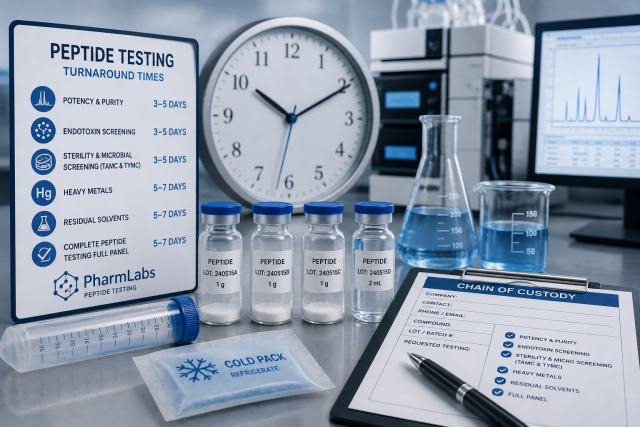
Heavy Metals testing is typically completed within 5–7 business days, and the Complete Peptide Testing Full Panel is also typically completed within 5–7 business days.
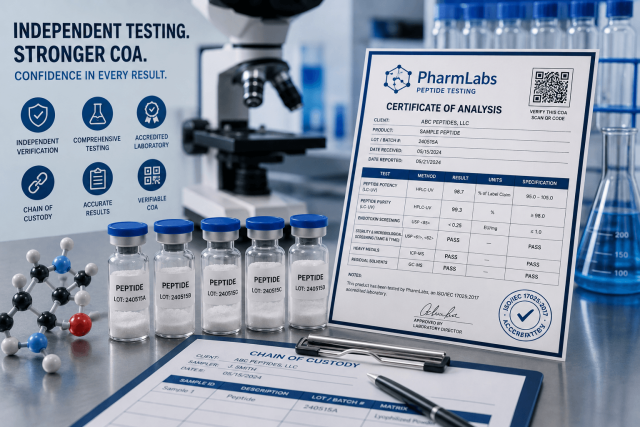
PharmLabs is an ISO/IEC 17025:2017 accredited analytical laboratory providing independent third-party peptide testing from our San Diego facility.
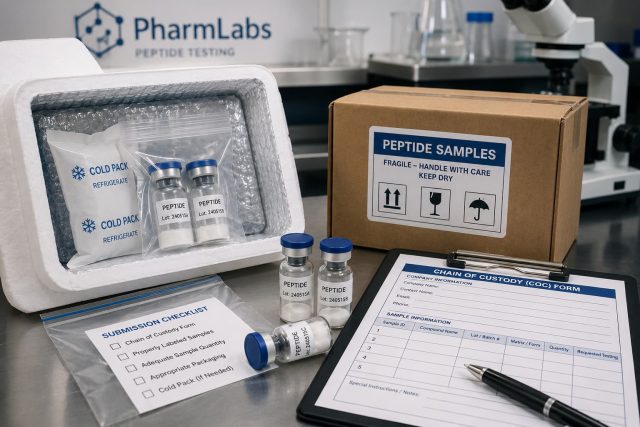
Our clients receive Chain of Custody traceability, clear Certificates of Analysis, secure COA verification, and access to their results through our client portal.
High Purity Doesn’t Mean “Contaminant Free”
A high peptide purity percentage can be an excellent result.
But it should be interpreted for what it actually measures.
Purity tells you about the target peptide relative to peptide-related impurities. It does not tell you whether heavy metals are present.
That’s why a broader quality program uses the right analytical method for each question.
For manufacturers and distributors who want more than a purity percentage, independent Heavy Metals testing can provide another important piece of the peptide quality picture.